
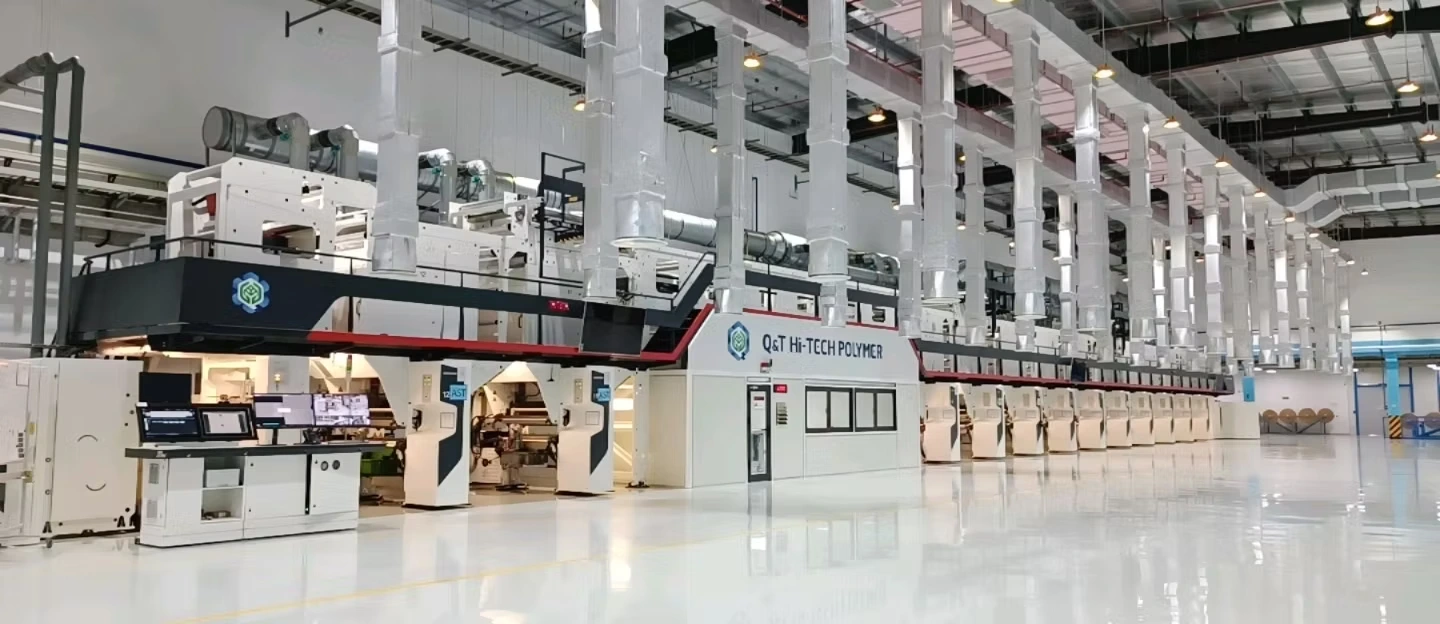
Q&T applies sheet-level automated verification across key production and packaging checkpoints, supported by process control, traceability, and documented quality records.
Substrate properties are precisely controlled through multi-parameter process optimisation — not merely declared by specification sheet. Every property that affects circulation performance is actively engineered.
Security features integrated within the substrate structure are designed to align feature durability with substrate service life. Surface-applied features remain compatible and are specified to programme requirements.
Consistency across production batches is maintained through multi-stage automated verification, closed-loop process control, and documented end-to-end traceability.
Banknote substrate performance is shaped across the full production chain — from film properties and surface treatment to security integration, inspection, traceability, and controlled dispatch.
Film properties, surface energy, and orientation controlled at source.
Security geometry defined through repeatable high-precision mastering.
Ink adhesion, opacity, and coating behavior tuned for currency printing.
OVD and covert elements integrated within the substrate structure.
Lot-control records connect material intake, process data, and finished output.
Optical and dimensional checks verify key sheet-level parameters.
Lot integrity, labeling, and dispatch records close the quality chain.
Each stage produces records that support the next stage, creating a verified and auditable production chain.
Film properties, surface energy, and orientation controlled at source.
Security geometry defined through repeatable high-precision mastering.
Ink adhesion, opacity, and coating behavior tuned for currency printing.
OVD and covert elements integrated within the substrate structure.
Lot-control records connect material intake, process data, and finished output.
Optical and dimensional checks verify key sheet-level parameters.
Lot integrity, labeling, and dispatch records close the quality chain.
Complete lot records closed, forming an auditable production chain.
Q&T operates an in-line high-resolution automated inspection system that examines substrate sheets across dimensional, optical, and surface quality parameters simultaneously, rather than relying on batch sampling alone.
Automated in-line inspection is used at defined production-control stages. Inspection covers dimensional, surface and window-integrity parameters, with disposition of sheets that do not meet the specification.
Length, width, and squareness verified against programme-specific specifications
Four-corner measurement protocol supports consistent press performance across the full sheet
High-resolution optical detection of pinholes, coating voids, and surface contamination
Clear zone geometry and position verified against design specification
Detection of cut defects and delamination at sheet edges before downstream finishing
Continuous in-line detection reduces the sampling uncertainty inherent in statistical quality control — the risk that a defective unit exists within an uninspected fraction of a batch.
Thickness uniformity across the full sheet — not merely at the centre — determines the consistency of printing press nip pressure. Non-uniform thickness produces non-uniform ink transfer, which manifests as print density variation in the finished note.
Thickness uniformity is monitored across defined sheet reference points. Consistent thickness supports consistent nip pressure on press, which supports reduced setup waste and spoilage rates, subject to printer validation.
Circulation studies and central bank survey data indicate that a substantial proportion of banknote rejections stem from surface deterioration — including ink layer abrasion, soiling absorption, and tactile wear — rather than base film failure.
Q&T's surface treatment is engineered specifically for each ink type deployed in the printing specification — offset, intaglio, screen printing, and machine-readable inks. Adhesion is characterised under simulated circulation conditions, not merely standard laboratory testing.
In high-security substrate manufacturing, traceability is not an administrative function — it is a security control mechanism. Substrate is tracked through documented lot-control records from raw material intake to delivered product.
Raw material lot origin and incoming polymer resin verification
Coating, cure, line speed and temperature logged at each stage
In-process measurements and optical sensor logs at each verification point
Operator identification and production shift records
Sheet-level accept, reject, and rework disposition decisions
Rejected material tracked through controlled and auditable disposal
Any substrate batch can be traced through its documented production records — material provenance, process parameters, quality records, and operator shift records. This makes the supplier relationship accountable rather than transactional.
Dimensional stability and surface consistency reduce registration errors and ink density variation across the full production volume.
Substrate-level dimensional and surface control supports reduced print shop rejection rates, subject to printer validation — offering operational efficiencies that complement substrate unit pricing.
Surface engineering tailored for ink adhesion is designed to extend note service life, supporting lower withdrawal and replacement rates subject to circulation environment and programme validation.
Targeted spoilage reduction, enhanced circulation durability, and regional logistics can contribute to a lower total cost of ownership over the currency lifecycle.
Batch-to-batch consistency in security feature geometry supports authentication sensor reliability across automated cash handling equipment.