
Accelerated laboratory testing provides a comparative estimate of relative performance and does not directly predict an absolute circulation lifespan.
PolySecure® is built on a proprietary polymer core with controlled opacification, surface treatment, and transparent-window zones. The architecture is designed to support overt optical features, covert machine-readable elements, and existing banknote production workflows.
ENGINEERED FOR TRANSITION FLEXIBILITY
Unlike fixed-thickness polymer platforms, PolySecure® uses a multi-layer architecture that allows substrate thickness to be configured around programme requirements. This provides greater flexibility when matching existing banknote dimensions and processing infrastructure.
Final compatibility remains subject to printer qualification and cash-processing equipment validation. Configurable thickness may reduce the scope of equipment adjustment across sorting systems, automated teller machines, and teller cash recyclers compared to rigid substrate platforms.
Substrate thickness can be configured around programme requirements, providing greater flexibility when interfacing with existing cash-processing infrastructure.
Q&T’s opacifying system is engineered to provide high whiteness, controlled opacity and reduced show-through while preserving clear-window areas.
The PolySecure® platform can support overt, covert and machine-assisted authentication features according to programme requirements. The platform can incorporate Q&T’s Laser Optical Feature (LOF), a covert polymer-window feature designed to reveal customised diffraction patterns under a point light source.
PolySecure® is engineered to support high-pressure intaglio printing and maintain tactile print performance under demanding circulation conditions. The independent Substrates Durability Assessment (May 2025) recorded lower intaglio wear for the Q&T substrate than the reference substrate tested.
Core physical material properties engineered for high-security banknote printing
| Property | Cotton-Paper Reference | PolySecure® Specification |
|---|---|---|
| Substrate architecture | Fibrous cotton rag | Multi-layer BOPP |
| Thickness | ~110 µm (standard) | Configurable within programme specification (~70–120 µm) |
| Basis weight | ~85–95 gsm | Programme-specific (~70–100 gsm) |
| Fold endurance | ~1,000 double folds | Programme-specified |
| Water behaviour | Absorbent cellulose network | Non-absorbent polymer structure |
| Surface | Natural porous fibre | Engineered for security printing |
| Opacity | Inherent to fibre furnish | Configurable opacified fields |
| Transparent / clear windows | Aperture required (non-native) | Supported (integrated BOPP clear window) |
Beyond basic durability, PolySecure® performs strongly against the fundamental metrics that define a premium circulating currency: Stiffness, Whiteness, and Opacity. These parameters directly impact public trust and automated processing efficiency.
Designed with configurable stiffness properties to align with diverse application and processing requirements. Substrate stiffness can be engineered around target programme specifications, supporting mechanical handling stability, automated sorting performance, and tactile consistency across high-security printing and cash-processing environments.
Configurable
Stiffness can be tailored to target programme requirements, from BOPP-film parity to enhanced rigidity for specific sorting and processing criteria.
Programme-specified
Fold endurance is verified against the target currency programme specification for BOPP-based polymer substrates.
Security-grade
Engineered for compatibility with high-speed sheet-fed and web-fed security printing presses.
Controlled substrate stiffness supports tactile print definition and tactile recognition features throughout circulating life, which influences perceived note quality and handling confidence.
Consistent stiffness characteristics facilitate reliable feeding, transport, and automated detection across commercial cash-sorting equipment.
Optimised dimensional and flexural properties assist in reducing press downtime and maintaining register stability during multi-pass printing.
PolySecure®’s economic model extends proven polymer precedents from 45+ countries
"QT substrate demonstrated a 79.5% ± 11.4% improvement in relative mean life compared with a reference polymer substrate."
Accelerated laboratory testing provides comparative relative-life estimates and does not directly determine absolute field circulation life.
"Q&T Hi-Tech Polymer has emerged as an innovative new player in banknote polymer substrate technology."
"POLYSECURE SHIELD was spotlighted as a polymer banknote substrate with an embedded OVD."
PolySecure® is reported to be used in Vietnamese national currency production. Independent industry reporting states that the State Bank of Vietnam has awarded Q&T polymer substrate contracts across four denominations. Q&T reports multiple supply contracts with the National Banknote Printing Plant since 2023.
Substrate awarded for national currency production across four circulating Vietnamese denominations.
Reportedly used in Vietnamese national currency production; deployment evidence is available in the technical dossier.
Relative mean-life improvement versus tested reference polymer substrate under accelerated circulation simulation.
10 domestic supply contracts with Vietnam's National Banknote Printing Plant since August 2023.
10 domestic supply contracts since August 2023. Vietnamese banknotes printed on Q&T substrate are in active circulation.
Programme modelling for comparative evaluation
PolySecure® lifecycle economics should be evaluated at programme level rather than from substrate price alone. Longer circulation life may reduce replacement volumes and associated printing, logistics, processing and destruction activity. Q&T’s cost-benefit model can be configured using denomination-specific circulation data, replacement rates, production costs and local cash-cycle assumptions.
Illustrative Q&T modelling indicates potential lifecycle savings versus cotton-paper under defined five-year programme assumptions. Q&T does not publish a lifecycle saving percentage; the figures are modelled per programme and are not universal performance guarantees.
Lower replacement note requirements over multi-year cycles reduce ongoing substrate procurement, print runs, and production waste.
A longer circulation life may reduce replacement frequency and associated procurement, logistics and destruction costs.
Lifecycle figures represent modelled programme scenarios based on defined assumptions and are not universal performance guarantees. Low ink consumption and low production waste have been reported in industry coverage of PolySecure® printing operations; actual ink consumption depends on denomination design, print process, ink system and production configuration. Customised programme modelling is available upon request.
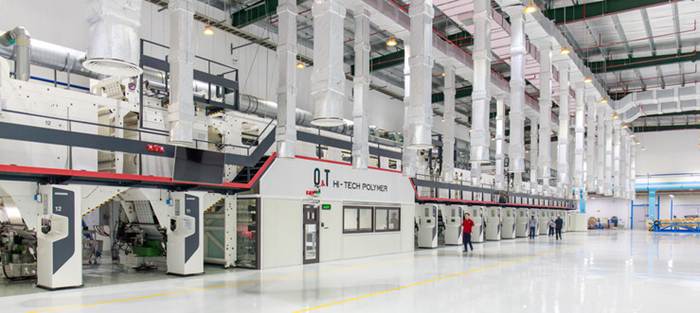
PolySecure® is manufactured at Q&T’s purpose-built facility in Hoa Lac Hi-Tech Park, Hanoi. The production platform includes high-speed printing and finishing systems (operating up to approximately 300 m/min), dual independent quality-control monitoring with automatic feedback from inspection to production, and solvent-recovery infrastructure designed to recover and reuse process solvents.
Learn more about our facility & sustainabilityOur technical team can provide detailed specifications, test data, and a comprehensive cost-benefit analysis tailored to your denomination and circulation requirements.