Vietnam Culture Day: The cultural stories behind every Vietnamese banknote
Marking Vietnam Culture Day on 24 November 2026 and the 80th anniversary of the First National Cultural Conference is an occasion to reflect on eight decades of Vietnamese currency, from the earliest banknotes of 1946 to today's modern polymer generation. Beyond their purely transactional value, each note is a slice of heritage, bringing together emblems that embody the nation's roots, culture and economic vitality — from Sen Village, Khue Van Cac, Phu Van Lau, Nghinh Luong Dinh, Chua Cau, Ha Long Bay to the Bach Ho oil field. Behind the durability of these currency issues lies the technological imprint of polymer substrate produced through research and manufacturing by Q&T — a wholly Vietnamese-owned enterprise — evidence of progress in mastering a strategic material to safeguard national currency security.
1946 – The Birth of a New Culture and an Independent Currency
On 24 November 1946, the first National Cultural Conference opened at the Hanoi Opera House, where President Ho Chi Minh issued a strategic call to action: "Culture must light the way for the nation." Exactly eight decades later, that historic milestone has been officially honoured as Vietnam Culture Day under Resolution No. 80-NQ/TW of the Politburo and Resolution No. 28/2026/QH16 of the National Assembly.
Also in that pivotal year of 1946, Vietnam’s first banknotes were issued, affirming the financial and monetary sovereignty of an independent nation. Throughout history, Vietnamese currency has served not only as an instrument of economic circulation but also as a “cultural ambassador,” bringing the country’s finest symbols into the daily life of every citizen.
Six denominations, six slices of culture
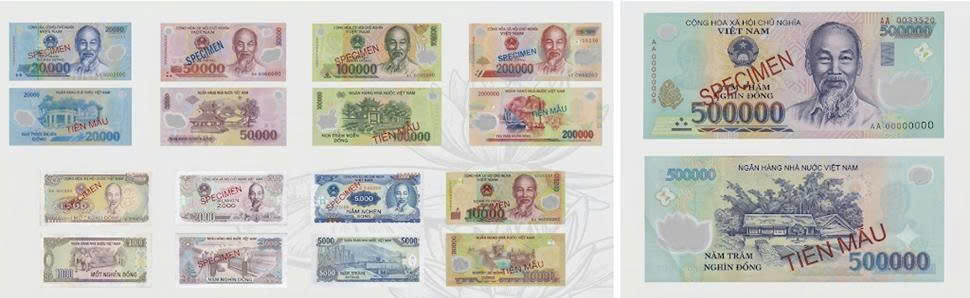
The current polymer banknote series comprises six denominations from 10,000 to 500,000 dong, forming a harmonious aesthetic whole across both faces. While the obverse brings together the nation's sacred symbols — from the portrait of President Ho Chi Minh and the national emblem to motifs of the bronze drum, imperial court patterns and traditional script — the reverse of each denomination opens onto its own distinct heritage space, distilling the essence of Vietnam:
500,000 dong – Roots and Character (President Ho Chi Minh's boyhood home in Kim Lien, Nam Dan, Nghe An):The humble thatched cottage nestled beside the hibiscus hedge evokes the moral principle of "remembering the source when drinking water" and his noble, simple way of life. That the highest-denomination banknote should depict the most modest of settings is itself a cultural message rich in philosophical meaning.
200,000 dong – Spirituality and natural wonders (Hon Dinh Huong, Ha Long Bay, Quang Ninh):The incense-burner-shaped rock rising from the open sea in Ha Long Bay, a World Natural Heritage Site, celebrates the majestic beauty of the land and evokes the tradition of ancestor worship and reverence for heaven and earth.
100,000 dong – Scholarship and the tradition of learning (Khue Van Cac, Temple of Literature – Imperial Academy, Hanoi):The emblem associated with Vietnam’s first university affirms a reverence for knowledge and the ethical principle of “respect for teachers and learning,” underscored by the finely wrought brush-and-inkstone motif on the transparent window pane.
50,000 dong – Royal architecture at its finest (Nghinh Luong Dinh and Phu Van Lau, Hue):Two ancient structures reflected in the Perfume River, part of the Complex of Hue Monuments, exemplify the refined architecture of the Nguyen dynasty.
20,000 dong – Openness and Cultural Exchange (Chua Cau, Hoi An):The unique covered bridge tied to the once-thriving Hoi An trading port symbolises a maritime outlook and the cultural fusion of the ancient town of Hoi An, a UNESCO World Heritage Site.
10,000 dong – A testament to labour and maritime sovereignty (Bach Ho Oil Field):The image of an offshore rig standing tall amid the open sea celebrates modern working culture and the aspiration to master science, technology and our nation's maritime resources.
Side by side, the six reverse designs form a complete cultural whole: roots, spirituality, knowledge, architecture, integration and labour, all brought together. These values do not sit static behind museum glass — they live and breathe alongside Vietnamese people through every transaction, every day.
Substrate material – the "canvas" that carries heritage and the PolySecure® mark
For intricate motifs such as the Khue Van Cac roof tiles or the hues of Ha Long Bay to appear vivid and retain their colour through years of circulation, the substrate plays a decisive role — much like the artist's "canvas". In banknote printing, this substrate must meet three stringent standards at once: optimal whiteness, opacity and flatness to render colour faithfully; dimensional stability to prevent image distortion; and outstanding mechanical durability to withstand millions of transactions. According to the State Bank of Vietnam, polymer banknotes last on average 2.5–3 times longer than cotton notes of the same denomination.
With the PolySecure® material line, Q&T has set a new quality benchmark. The product withstands more than 40,000 consecutive folds without deterioration, far exceeding current technical standards, while ensuring substrate hue accuracy that keeps heritage colours consistent across print runs. Notably, the independent Substrates Durability Assessment (May 2025) found that PolySecure® delivers 79.5% longer circulation life (±11% margin of error) than the reference material. These test results not only confirm outstanding economic and technical performance, but also help national cultural symbols endure longer in community life.
Multi-layered security and DOE diffractive optical features
Every polymer banknote is protected by a multi-layered security system that lets the public verify it easily by ordinary sensory checks, following State Bank of Vietnam guidance:
Backlight inspection:The latent portrait of President Ho Chi Minh reveals both sides; the security thread and registration feature align precisely.
Lightly swipe the front:Intaglio printing creates raised, textured relief on portraits, national emblems and denomination numerals.
Tilt the banknote:Optically variable ink (OVI) shifts colour depending on the viewing angle (on the VND 100,000, 200,000 and 500,000 notes); an iridescent IRIODIN stripe runs along the body of the note; a latent image stands out clearly on the VND 10,000, 20,000, 50,000 and 200,000 denominations.
Observe the transparent window:Large embossed window featuring the denomination and motifs such as a stylised lotus (VND 500,000) or brush and inkstone (VND 100,000).
In-depth review:Microtext, colourless ink and luminescent serial numbers are clearly visible under a magnifying glass and UV light.
Each denomination has its own security feature set, tailored by position and type (for example, the VND 100,000 and VND 500,000 notes combine colour-shifting ink with DOE in place of a latent image, while the VND 200,000 note incorporates both). Behind these sophisticated layers of protection is a core technology portfolio — from security watermarks and anti-static coatings to optically diffractive structures and hologram-integrated substrates — all covered by Q&T patents.
The most distinctive of the public security features is the DOE (Diffractive Optical Element), integrated into the small window at the upper corner of the front of four denominations: 50,000, 100,000, 200,000 and 500,000 dong. When the small window is held close to the eye and viewed through toward a point light source (such as an incandescent bulb or a flame), the hidden image appears sharply around the light source on genuine notes. This effect is created by a micrometre-scale microstructure engineered to bend light rays according to a predetermined pattern; because it is not produced by printing ink, it cannot be counterfeited by any ordinary copying device. For the diffractive image to be sharp, the window must achieve absolute transparency and smoothness – a pioneering technology patented by Q&T. The State Bank recommends that the public check at least 3–4 security features and compare them against a genuine note of the same denomination; preserving the integrity of the currency is also a way of protecting the cultural values embodied in it.
Q&T – In-house core material technology: taking Vietnamese expertise global
After nearly two decades of importing all polymer banknote substrate material, in June 2017 Polymer High-Tech Company Limited Q&T began an independent R&D journey to develop multilayer substrate technology, free of reliance on foreign transfer. In 2023, the PolySecure® product was accepted by the National Banknote Printing Plant and entered official circulation in 2024. To date, Q&T has completed more than 10 consecutive supply contracts for the National Banknote Printing Plant, demonstrating consistent quality and the capacity to meet the most stringent standards.
Q&T is the first and only manufacturer of polymer substrate for banknotes in Vietnam, ASEAN and across Asia. Its plant complex at Hoa Lac Hi-Tech Park (Hanoi) represents over VND 1,000 billion in investment, with a capacity of 2,600 tonnes per year, over 90% localisation of raw materials, fully electrified operations and closed-loop solvent recovery, resulting in no direct CO₂ emissions. The company's capabilities are underpinned by international standards (ISO 9001, 14001, 27001, 45001; INTERGRAF 15374:2023 security standard for the security printing industry), its participation in drafting the national standard TCVN 13986:2024, 22 patent applications (7 patents granted), a First Prize at the VIFOTEC Awards 2025 and the WIPO Award for Inventors in May 2026.
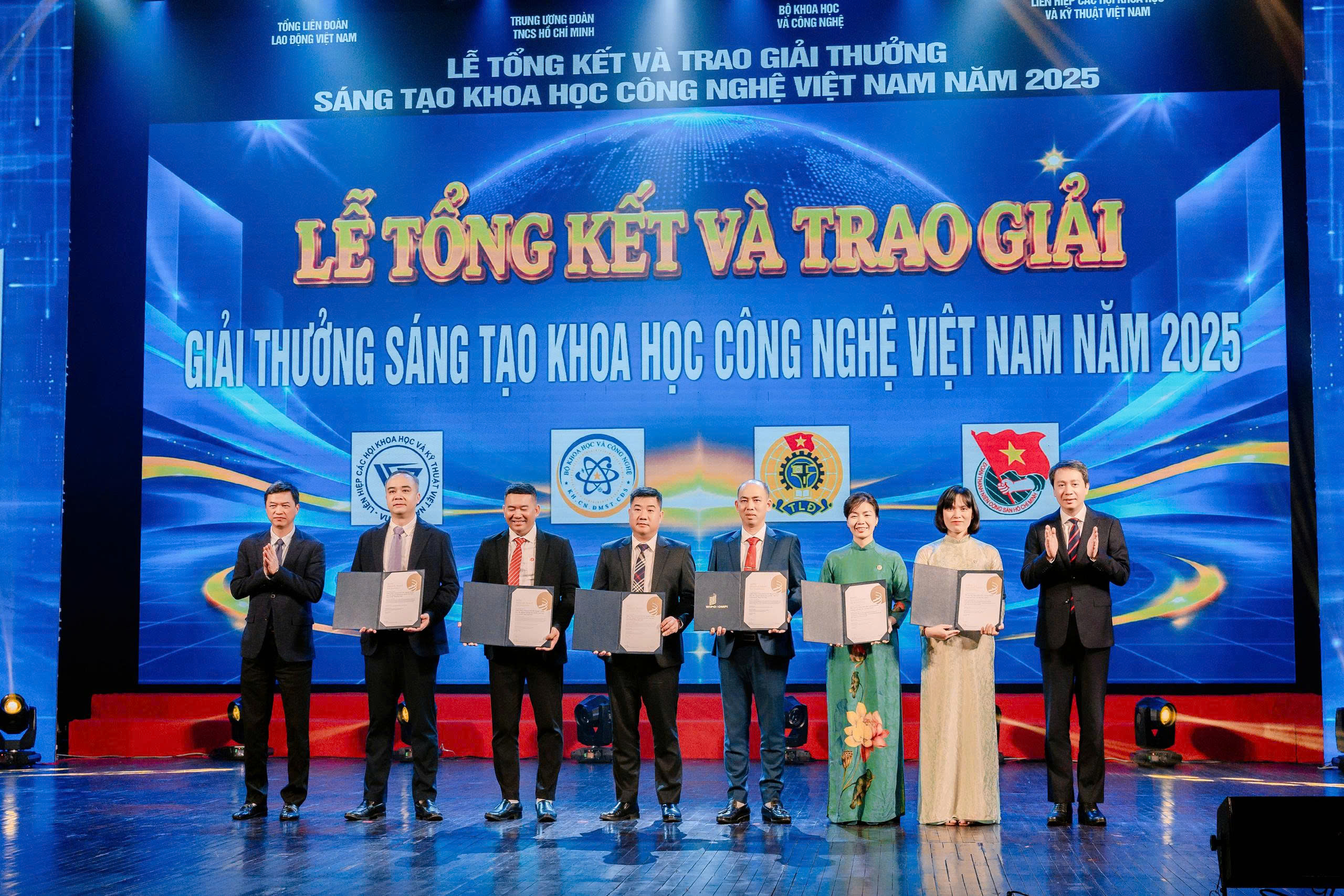
On the PolySecure® platform, Q&T continues to advance PolyShielded – a generation of material that integrates optical security features directly into the core of its multilayer structure rather than applying them as a surface coating, improving abrasion and chemical resistance and decisively eliminating any risk of delamination or counterfeiting.

Beyond the domestic market, Q&T has recorded its first export orders and is pursuing partnerships with a number of central banks and banknote printers across Asia, Africa, the Middle East and Latin America. At the Banknote Conference 2026 in Washington D.C., Q&T was the first and only Asian company to both present a scientific paper and host an exhibition booth at the event.
From Vietnam's shift to a new banknote substrate to mastering multilayer polymer production technology, each milestone reflects a drive for innovation and greater self-reliance. Building on core technology research, industrial-scale manufacturing capability and a strategy of international cooperation, Q&T is steadily establishing itself as a Vietnamese technology brand in security polymer materials, with its sights set on deeper participation in the global currency technology value chain.