.png)
PolyShielded™: Embedding Optical Security Features Within the Polymer Substrate
Q&T's embedded-security architecture moves selected optical security features from the surface into the polymer substrate structure.
The embedded-security technology introduced by Q&T in 2025 as POLYSECURE® SHIELD is now presented within Q&T's product architecture as PolyShielded™.
Optically variable devices (OVDs) are widely used as visual security features on modern banknotes. When applied to the surface of a banknote, however, these features remain exposed to abrasion, repeated folding and crumpling, as well as environmental and chemical contamination.
Q&T developed its embedded-security architecture to address this exposure by positioning selected optical security features within the polymer substrate structure.
Today, this technology is represented by PolyShielded™, Q&T's embedded-security polymer substrate platform.
From Surface-Applied to Embedded Security
In a conventional surface-applied configuration, the optical security feature sits on the exterior of the substrate.
PolyShielded™ changes this architecture by placing the OVD between polymer layers. The feature therefore becomes part of the substrate structure rather than remaining exposed only on the finished surface.
The objective is to provide additional physical protection for the optical feature while preserving its role as a visible banknote security element.
Two OVD Integration Routes
Q&T has developed two approaches for integrating OVD technologies within the polymer substrate.
Hot-stamped OVD
An OVD foil can be hot-stamped onto one of the polymer laminate layers before adhesive coating and final lamination.
UV cast-and-cure OVD
An optical microstructure can also be formed using a UV-curable coating applied to one of the polymer laminate layers before subsequent processing and lamination.
These approaches allow embedded OVDs to be implemented in different formats, including patches and stripes.
Demonstrated OVD Configurations
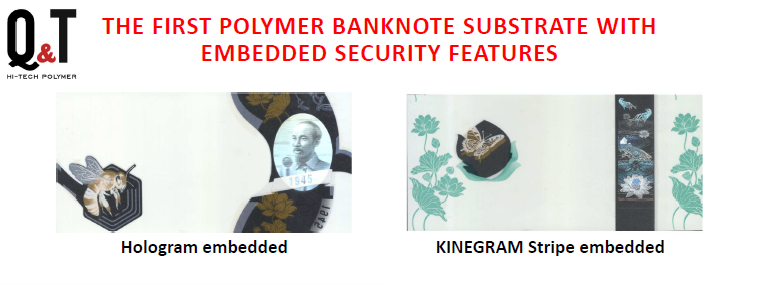
Q&T has produced demonstration banknotes using both integration approaches.
Examples include an embedded UV cast-and-cure OVD patch and a hot-stamped embedded demetallised KINEGRAM® registered stripe.
These samples demonstrate how different optical technologies can be incorporated within the same embedded-security substrate concept.
Reducing Exposure to Surface Wear
Surface-applied OVDs can be affected by repeated handling, folding, rubbing and scratching, as well as moisture, dirt, ultraviolet exposure and chemical contamination.
By positioning the OVD within the polymer structure, PolyShielded™ is designed to reduce direct exposure of the optical feature to these circulation stresses.
Building on the PolySecure® Platform
PolyShielded™ builds on Q&T's PolySecure® polymer substrate platform by extending the substrate architecture to support embedded optical security.
Rather than treating the substrate and optical feature as separate surface components, the embedded approach allows selected security technologies to be incorporated within the multilayer substrate structure.
The platform is intended to support continued development of embedded-security applications for future polymer banknote programmes.
Continuing Development
PolyShielded™ represents Q&T's ongoing development of embedded-security polymer substrate technology.
Q&T continues to develop the platform with optical security technology partners and to explore additional configurations for future banknote applications.